
|
NHBR · Governors Bridge Where your $125 goesOne flat price, all-in — and two-thirds of every dollar goes to patrol. |
|||||||||||||||||
|
Governors Bridge runs on a single flat rate: $125 / household / month, all-in. No cameras to buy, no equipment to own — one predictable number, month-to-month. Here is exactly how each dollar is put to work, measured at our 100-household target.
66¢ of every dollar is on the street. What the patrol dollar buys — it tightens as we grow
Every neighbour who joins tightens the patrol — for everyone. Patrols are deliberately randomized, so they can never be timed or predicted. Included for every household, at the one flat price
|
|||||||||||||||||
| Privacy first: no facial recognition · cameras read licence plates, not people · public roadway only, never private property · data stored securely in Canada · 30-day retention · clear signage. Register: nhbr.ai/nhbr-safety-governors-bridge — no one is charged until 75 households join. |
Frequently Asked Questions
1. Why is the community changing security programs?
Registration for the previous program dropped below the number of households needed to sustain it, and residents raised concerns about pricing and service quality. A volunteer Community Security Committee was formed to find the best path forward. It reviewed multiple providers, technology-enabled solutions, resident feedback, and neighbouring communities — weighing the cost, benefit, and long-term sustainability of each option.
2. Why did the committee choose NHBR?
After a careful review, the committee concluded that combining intelligent monitoring with professional patrols was the strongest solution: broader coverage, greater flexibility, and a more durable long-term approach, while keeping professional patrols ready to deploy whenever incidents occur.
Additional benefits:
- Well positioned for future technology
- Better identification of suspicious vehicle activity
- Visible signage as a deterrent
- Patrols guided by real-time intelligence rather than fixed schedules
- The option to connect home alarm systems directly to the patrol service
The committee also valued NHBR's willingness to tailor the program to Governors Bridge. Independent research shows ALPR is most effective when paired with visible patrols — one U.S. community using this model saw a 44% drop in major crime and a 54% drop in auto theft.
3. Why adopt newer technology?
Neighbourhood crime keeps evolving, and many incidents now involve vehicles moving quickly between communities. Technology adds a layer of awareness patrols alone can't provide; identifying suspicious vehicles, detecting unusual activity, guiding smarter patrol deployment, preserving evidence, and deterring through posted signage.
4. What does the program cost, and why a flat $125?
$125 plus HST per household per month, based on a target of 100 participating households. A single community-wide fee - rather than tiered pricing - is more transparent and ensures every household contributes equally.
The committee chose $125 over a lower-priced option because the extra contribution meaningfully increases patrol frequency for a modest added cost. If participation exceeds 100 households, the additional revenue expands patrol coverage by shortening the time between passes. Billing is month-to-month.
5. Will there still be security patrols? How often?
Yes - professional patrols remain central. Instead of the same predictable overnight route, patrols run on randomized schedules set by neighbourhood priorities and intelligence, making them harder to anticipate and more effective.
6. What are the communication channels?
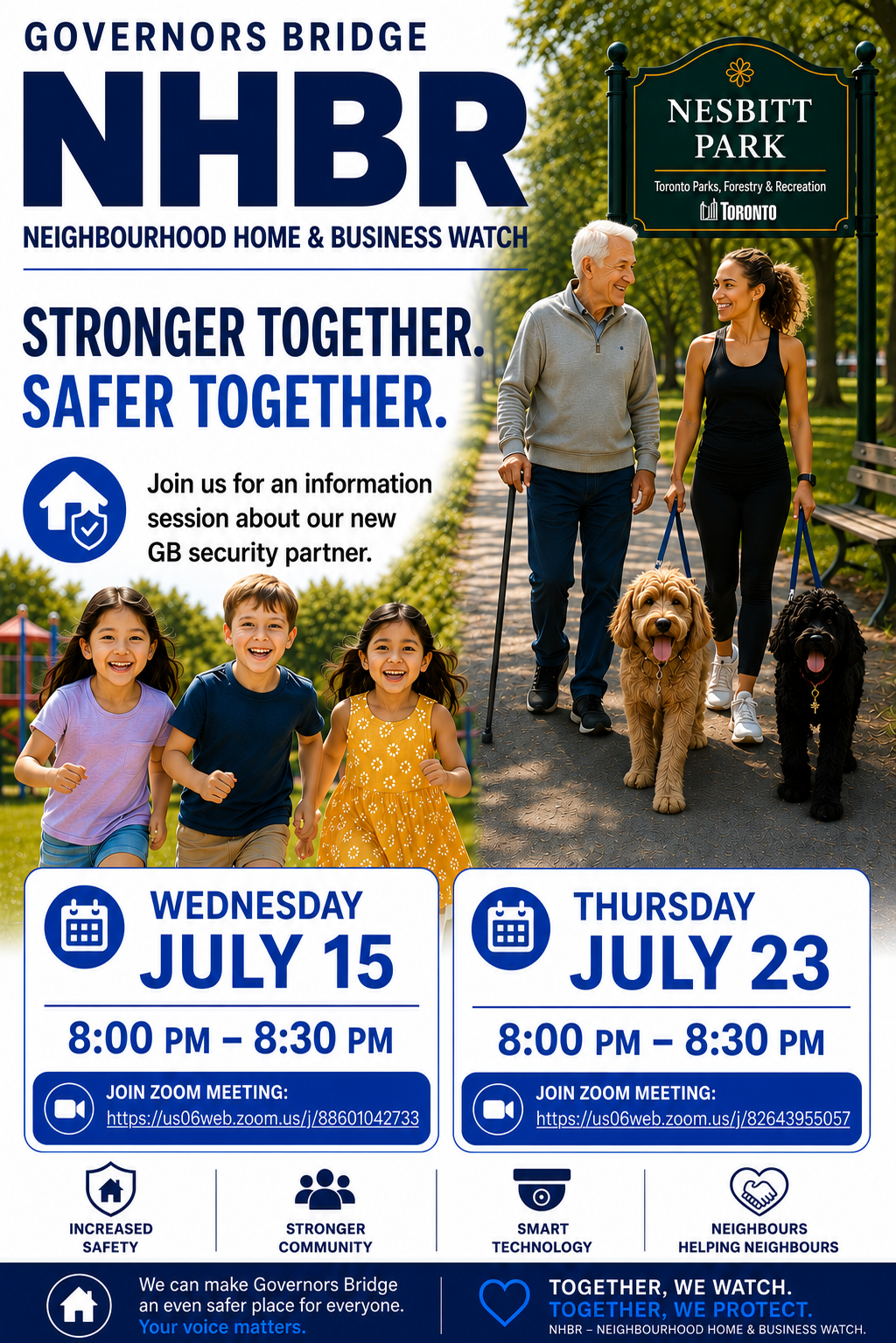
NHBR will run a dedicated Governors Bridge WhatsApp group for real-time alerts, patrol updates, and resident reports. Residents also receive email updates and a dedicated registration page.
7. Didn't the previous overnight patrol offer more coverage and faster response at night?
The previous program stationed a guard in the neighbourhood during scheduled overnight hours — fast response while on site, but predictable, with no coverage outside those hours. The new model provides continuous ALPR monitoring, 24/7 on-demand response, and intelligence-led deployment.
8. How does the technology work? Cameras at the entrances read the licence plates of vehicles entering and leaving. The system checks each plate against approved resident vehicles, vehicles of interest, and suspicious patterns. When something suspicious is detected, a live NHBR operator reviews it and either directs a patrol already in the area or dispatches the nearest available one. If a crime is underway, Toronto Police are contacted in parallel. Average response is about 1 minute when a patrol is already in Governors Bridge, and about 16 minutes when the nearest patrol must be dispatched.
9. How effective is ALPR?
It's used in thousands of U.S. communities and helps resolve roughly one in five reported crimes where it's deployed. Governors Bridge will be among the first communities in Canada to adopt it at the neighbourhood level, benefiting from favourable early pricing.
10. How accurate are the cameras? Positioned for maximum effectiveness, the technology currently reads licence plates with more than 93% accuracy.
11. Where will the cameras be located? At the two entry points into Governors Bridge. A third may be added if needed for coverage or to work around obstructions.
12. When will the cameras be installed? Once the community reaches the activation threshold of 100 households, installation follows within about 30 days.
13. What will the patrol vehicles look like?
Clearly marked with professional security branding, with officers fully uniformed and equipped.
14. What about privacy?
Privacy was a top committee priority. The system:
- Uses no facial recognition
- Focuses only on vehicles entering and leaving
- Does not monitor private property
- Stores data securely in Canada, with roughly 30-day retention
- Uses clear signage
- Operates in accordance with applicable privacy legislation
15. How are emergencies and response times handled?
Trained operators assess each situation and dispatch a patrol when appropriate, and contact Toronto Police whenever police intervention is required. When a patrol isn't already in Governors Bridge, average response is about 16 minutes. The previous program averaged about 1 minute while a guard was on site during scheduled hours, but offered no coverage outside them. The new model trades continuous on-site presence for continuous neighbourhood awareness and response.
16. How will we know if it's working? The committee will regularly review resident feedback, security incidents, patrol activity, participation, and operational performance, and look for ways to improve. This is an evolving program, not "set it and forget it."
17. Can the program change over time? Yes. As technology and community needs evolve, the committee will refine it. Billing is month-to-month.
18. Why wasn't the previous patrol program selected?
The committee valued the previous program, but concluded that combining technology with professional patrols delivers broader coverage, greater flexibility, and stronger long-term value.
19. What did the community survey tell us?
Thanks to the 135 households that took part. About 90% have concerns about neighbourhood security, 69% are open to a community security solution, about 70% named visible patrol vehicles as the most important feature, and home invasions were the top concern for 58%.
20. Will residents be able to review all the options considered?
The committee was formed to evaluate solutions on the neighbourhood's behalf, and put significant time into vendors, service models, neighbouring communities, provider meetings, and resident feedback. Its recommendation reflects that review.
21. Tell me more about NHBR and its partners.
NHBR delivers neighbourhood security that combines intelligent monitoring, professional patrols, and 24/7 response. Patrol and response are provided through RSPNDR, a North American security platform that coordinates licensed providers through intelligent software and real-time dispatch. The committee has worked directly with Craig Campbell, Founder and Executive Chair of both NHBR and RSPNDR, and a Rosedale resident familiar with Governors Bridge.
22. How will NHBR respond to an incident?
Response begins immediately after detection, whether from a camera or a resident report. Operators verify the situation, decide on a response, and dispatch the nearest patrol, contacting Toronto Police in parallel where appropriate. Residents are updated through the WhatsApp group when relevant.
23. What would patrols do during an incident?
Investigate the reported or detected incident. If a crime is in progress, they contact Toronto Police immediately via 911.
24. How do the vehicle lists work? -
Whitelist: approved resident, family, and visitor vehicles
Blacklist: vehicles flagged by residents as suspicious, or identified by police as stolen or wanted
Greylist: vehicles flagged by NHBR technology for suspicious patterns (for example, repeated unusual overnight entries)
25. Is this a GBRA initiative?
No. It's a community initiative operating independently of the Governors Bridge Residents Association.
26. How do I sign up?